Commercial Recycling Services in London
Recycling services
Commercial Recycling Services in London
Recycling collections for London offices, shops, hospitality sites, workspaces and other businesses. Tell us the postcode, the materials and how much space you’ve got. We’ll recommend a workable stream setup and quote the site you describe, not a generic tariff.
Request a recycling quote
Tell us the postcode, what the business produces each week and where the containers would sit. A person replies with a question or a price.
Or email office@capitalrecycle.co.uk · WhatsApp photos of the bin area to the same number.
Commercial recycling for London businesses
DMR, card and paper, and glass options
Waste transfer records supplied
Upper-tier carrier CBDU466346
What commercial recycling services can London businesses use?
Commercial recycling in London works best when each material has a clear route from the point it’s thrown away to the point it’s collected. Recycling London is operated by Capital Recycle Ltd and covers three recurring collection needs: mixed dry recyclables, higher-volume cardboard and paper, and glass bottles and jars.
Dry mixed recycling collection for London businesses
Dry mixed recycling, usually shortened to DMR, puts compatible clean and dry materials into one recycling container. The exact mix is agreed with the collector. Plastic and metal packaging can normally share a DMR stream. Paper and card need separate consideration under the current rules. See how our dry mixed recycling collection works.
Cardboard and paper recycling for London businesses
A dedicated cardboard and paper stream suits premises where boxes or office paper make up a large share of the weekly waste. Keep it dry and away from food residue and it stays worth recycling. Read about commercial cardboard and paper recycling.
Glass recycling collection for London businesses
Glass is collected as a dedicated stream, never inside our standard DMR. The service is built around a movable 240-litre glass bin, because bottles and jars get heavy quickly. Read about dedicated commercial glass recycling.
How does commercial recycling collection work in London?
A commercial recycling collection starts with the premises, not a generic online tariff. We ask what the business produces, how the material is stored at the moment, when it can be put out and whether bags or bins make better use of the space you’ve got.
A London recycling assessment begins with the waste stream
Sort the recurring materials into broad groups: dry packaging, card and paper, glass, food and non-recyclable waste. A photo of the current storage point helps. It shows volume and access better than a guess in litres.
A London recycling quote matches container and frequency
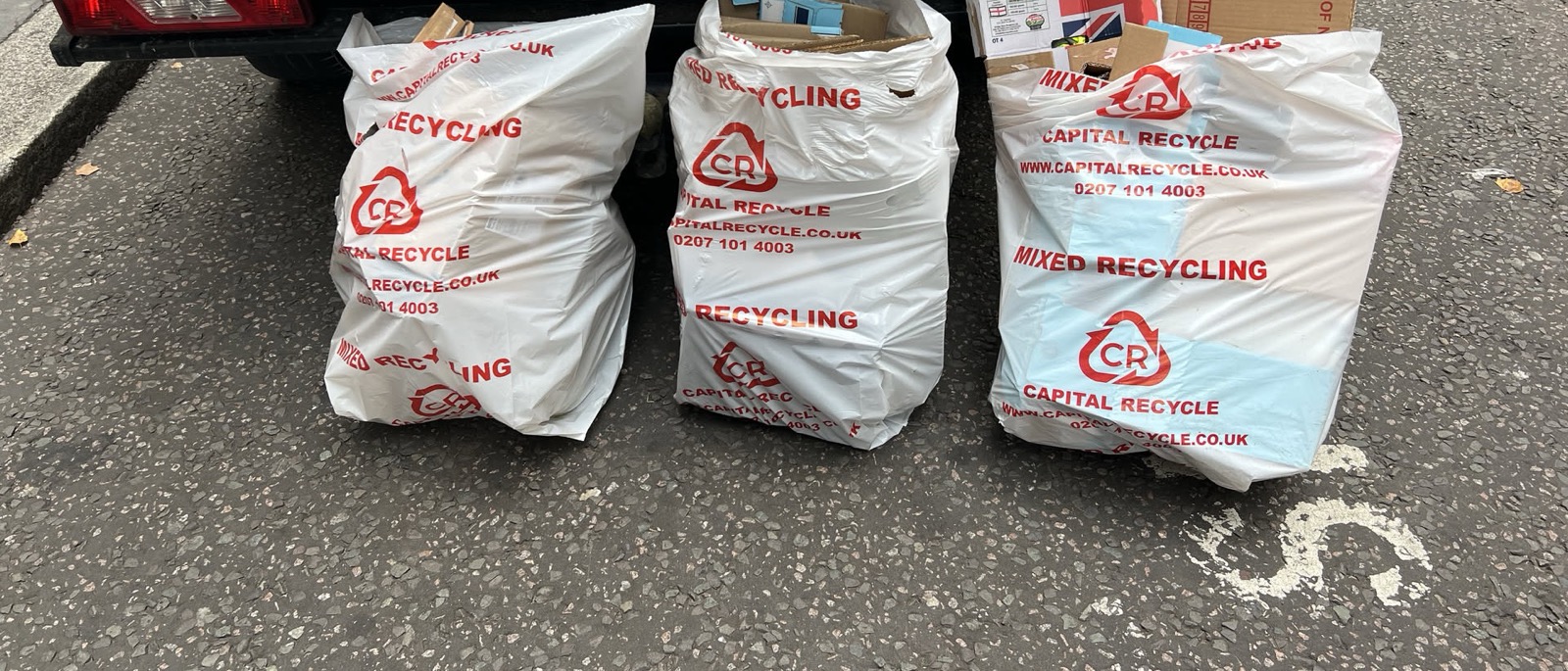
The collection format depends mainly on the material and the weekly volume, and on how much storage space is available. A small central London premises may need sacks because a large bin can’t stay on site. A higher-volume site with a secure storage point may be better off with bins. For container detail, use Capital Recycle’s commercial bag collection and commercial bin collection pages.
London recycling paperwork follows the agreed setup
Recurring non-hazardous collections can be covered by a waste transfer season ticket for up to one year, as long as the parties and the waste types stay the same. The document records what is transferred and who carries it. Businesses should keep the relevant record for two years.
What goes in commercial recycling in London?
What goes in a commercial recycling container depends on the material specification agreed with the collector. The national rules define the broad streams. They don’t turn every recycling container into one universal list.
Clean and dry materials belong in London dry recycling
Plastic and metal packaging are the usual dry-recycling materials. Empty them and keep them free from food and liquid. Wet or heavily soiled packaging can contaminate a load that would otherwise recycle. For anything else, check the accepted-materials list we give every account.
Paper and card need a clear London recycling arrangement
Current guidance says paper and card are collected separately from plastic, metal and glass by default. A collector may co-collect them only where it holds a valid written co-collection assessment. Ask what arrangement applies to your site rather than assuming a mixed label covers everything.
Glass and food stay outside our London DMR stream
Glass has its own collection on this service. Food waste must also be kept separate from dry recycling and residual waste. If your premises produces food waste, include it in the assessment and ask us about the right collection route, so the whole setup is considered rather than the dry streams on their own.
What do Simpler Recycling rules mean for London businesses?
Current guidance says workplaces in England must separate dry recyclable materials, food waste and residual waste before collection. The workplace rules changed on 31 March 2025. Micro-firms with fewer than 10 full-time-equivalent employees have until 31 March 2027.
London workplaces must agree separation with their collector
The practical setup is made with the waste collector. A business can use container sizes and collection frequencies that suit its volume. The legal requirement is about keeping the required streams separate, not buying a particular number of bins. Nothing stops you splitting streams between collectors either; we take on single streams (see the questions further down).
London micro-firms should prepare before 31 March 2027
The micro-firm test is fewer than 10 full-time-equivalent employees, and our reading of the guidance is that the count belongs to the business as a whole, not to one branch. A business with several small locations may still be in scope even when each site has fewer than ten people. Our Simpler Recycling guide for small businesses can help you work through the deadline.
London businesses still have a wider waste duty of care
Separation is only part of the job. A business has to stop its waste escaping, describe it properly and only hand it to someone authorised to take it, under the waste duty of care code of practice. Capital Recycle Ltd is registered as an upper-tier carrier, broker and dealer under registration CBDU466346.
How is a commercial recycling quote calculated in London?
A commercial recycling quote reflects what is collected and what it takes to collect it. We don’t publish a recycling price table on this site because a headline number without the premises details is likely to mislead.
London recycling volume and frequency shape the quote
The main inputs are the number of bags or bins, the expected weight, how many collections a week and whether the material is genuinely separated. A clean stream can be a different job from a container carrying mixed residue.
London recycling access and presentation shape the quote
Access matters. Tell us how far the container has to move, whether steps or locked access are involved and whether the local authority restricts when waste can go out on the pavement. These details shape the collection design before they touch the price.
A London recycling quote should state the agreed stream
Compare quotes on the same basis. The stream, container, frequency, access assumptions, waste records and VAT position should all be clear. If one quote leaves those vague, it isn’t comparable with another yet.
Why choose Capital Recycle for commercial recycling in London?
Recycling London is a service website operated by Capital Recycle Ltd. It isn’t a second waste company. The contract and the collection sit with Capital Recycle Ltd, and so does the carrier registration.
Commercial recycling in London has an accountable operator
Capital Recycle Ltd is an active company registered in England and Wales, company number 14062640. The Environment Agency public register lists it as an upper-tier carrier, broker and dealer under CBDU466346. Both are public records a customer can check before handing waste over.
Commercial recycling in London is designed around the site
We match the stream and container to the premises. A compact site shouldn’t be forced into a bin it can’t store. A cardboard-heavy site shouldn’t pay for an arrangement that treats every box as residual waste. The assessment is there to find the split that works.
Commercial recycling guidance stays connected to collection
The guides on this site answer the practical questions that change a recycling setup: what goes in commercial recycling, how contamination happens and what small firms need to do before 2027. Each guide points back to the service page that owns the collection decision.
Commercial recycling questions for London businesses
Can a London business order only the recycling stream it needs?
Yes. Tell us what’s already covered and which recycling stream is missing, and we’ll assess that collection on its own.
Is commercial recycling in London collected in bags or bins?
Both can work. Bags suit tight premises with variable volumes, while bins make more sense once the volume is steady and there’s somewhere to keep them. Glass is a dedicated 240-litre bin only on this service.
Why are commercial recycling streams separated in London?
Different materials need different handling. Capital Recycle keeps glass outside DMR, and food must stay separate from dry recycling and residual waste. The site assessment turns those rules into a practical container plan.
Can one London premises use more than one recycling provider?
Yes. A business can use different providers for different waste streams. Each collector’s scope and paperwork should be clear so nothing falls between the arrangements.
Can one season ticket cover recurring London recycling transfers?
Yes, where the same non-hazardous waste moves between the same parties. The season ticket can cover repeated transfers for up to one year, and the business should keep the relevant record for two years.
What information gives the most accurate London recycling quote?
Send the postcode, business type, material streams, rough weekly volume and a photo of the storage point. Those five things usually answer what a generic calculator can’t.
Get a commercial recycling quote in London
Tell us where the premises is and which materials it produces. A person will look at the site details and come back with the collection format that fits. You can also call 0207 101 4003 or WhatsApp the same number.
Request a recycling quote
Tell us the postcode, what the business produces each week and where the containers would sit. A person replies with a question or a price.
Or email office@capitalrecycle.co.uk · WhatsApp photos of the bin area to the same number.